

Key takeaways
- Travel changes what "slim" has to mean. A power bank that is thin enough to disappear into a jacket pocket or a passport sleeve matters more at an.
Travel changes what “slim” has to mean. A power bank that is thin enough to disappear into a jacket pocket or a passport sleeve matters more at an airport than raw capacity, because the best battery is the one that is actually in your pocket when a gate change leaves you stranded with a phone at fifteen percent. The decision behind this keyword is the trade between thickness and stamina: five thousand milliamp-hours gives you about one phone top-up in a magnetic wafer, while ten thousand or fifteen thousand adds roughly one extra charge and a thicker body.
This guide is for travelers who want compact power for flights, trains, and city days in 2026. Each product is judged only on its title, so thickness, weight, and cable details come from the listing when they appear and are marked “check the listing” when they do not. Airlines generally require power banks in carry-on bags, and rules on capacity vary by carrier, so confirm before you fly. Choose a bank with flight-safe wording where it appears, but always verify the policy yourself.
Quick Picks
Our top picks


As an Amazon Associate we earn from qualifying purchases at no extra cost to you.
| Product | Best for | Key spec from the title |
|---|---|---|
| INIU 10000mAh 45W (Detachable Cable) | Fast charging for phones and tablets | 10000mAh, 45W, detachable USB-C cable |
| Slim Magnetic 5000mAh Bank | Attaching to an iPhone | 5000mAh, slim magnetic, USB-C charge |
| Anker Nano Magnetic 5,000mAh | Thinnest pocketable top-up | 5,000mAh, Qi2 15W, 0.34 in thick |
| Anker 10,000mAh PowerIQ | Simple, compact USB-C bank | 10,000mAh, 5V/3A, USB-C |
| VIYISI Ultra Slim 10000mAh | Built-in cable in a thin body | 10000mAh, PD 20W, built-in USB-C cable |
| 15000mAh 4-Cable Slim Bank | Longest stamina with built-in cables | 15000mAh, 4 built-in cables, 22.5W |
| INIU 10000mAh 45W (Built-in Cable) | Cable-free travel with a display | 10000mAh, 45W, USB-C cable, LED display |
How to Choose
Pick capacity by the trip, not the number
Five thousand milliamp-hours is a single top-up for most phones, which is enough to bridge a layover or an evening out. Ten thousand covers roughly two phone charges, and fifteen thousand stretches to a long travel day with a tablet or earbuds. Remember that conversion losses mean you will not see every milliamp-hour reach the device. For a weekend city break, ten thousand is the practical middle, while a magnetic five thousand is ideal when the priority is staying out of the way.
Thickness and the magnet question
Magnetic banks snap to the back of an iPhone and charge wirelessly, which removes the cable entirely. They are the thinnest option, with the Anker Nano listed at 0.34 inches, but they charge more slowly than a wired USB-C connection and depend on case compatibility. Check that your phone supports magnetic alignment and that a thick case does not weaken the grip. A traditional slim bank with a cable is faster, and for a tablet or an Android phone it is usually the better choice.
Cable design and ports
A bank that can recharge quickly through its own USB-C input is easier to live with in hotel rooms, where outlets are scarce. Built-in cables, as on the VIYISI and the second INIU, save you from carrying another cord, though a damaged built-in cable is hard to replace. Detachable cables are easier to swap but easy to lose. Count the ports: a single USB-C is enough for one device, while a bank with a four-cable design serves a group. Wattage matters for speed, so 20W suits phones and 45W suits tablets and some small devices.
Travel rules and handling
Weight adds up faster than people expect, so check the listing for ounces if you travel with a carry-on only. Keep banks in carry-on bags, and avoid packing them where they can be crushed. Several listings use flight-safe wording, but airline policy decides what is allowed, and limits vary by carrier. Budget banks sometimes cut corners on casing strength, so protect a thin bank in a pouch. Do not charge a bank under a pillow or in a hot car, and stop using any unit that swells or becomes unusually hot.
The 7 Best Options
INIU 10000mAh 45W Power Bank with Detachable Cable
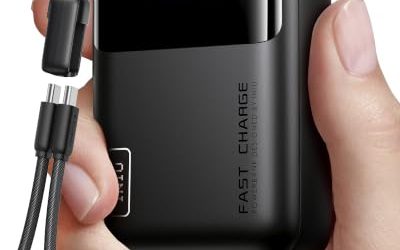
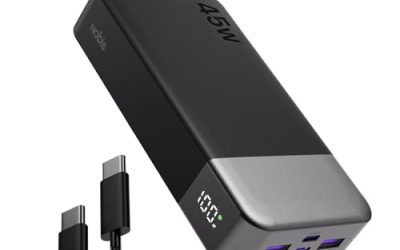
This INIU model is for travelers who want faster speeds than a typical slim bank. The title lists 10000mAh, 45W fast charging, a smaller travel design, flight-safe wording, and a detachable USB-C cable, and it appears in more than one listing.
- Strength: 45W output is high for a bank this size and suits tablets as well as phones.
- Strength: a detachable USB-C cable lets you replace it if it frays.
- Trade-off: a separate cable is one more item to keep track of in a bag.
Skip it if you want a built-in cable. It suits travelers who carry a phone and tablet and value the faster speed. Pack the cable in the same pouch as the bank, and consider a short one, since a long cord tangles easily in a seatback pocket or a crowded gate area.
Slim Magnetic 5000mAh Power Bank for MagSafe
This generic-listing model targets iPhone owners who want a wafer-thin top-up. The title lists 5000mAh, a slim magnetic design for MagSafe, travel essentials, and USB-C charging for the bank itself.
- Strength: magnetic attachment removes the cable from a quick top-up.
- Strength: a slim body is easy to hold with the phone.
- Trade-off: a magnetic bank is slower than wired charging, and compatibility depends on the phone and case.
Skip it if you use an Android phone without a magnetic case. It suits iPhone users who want a pocketable bank for city days. Because the title is generic, read the listing for details on size, weight, and which iPhone generations are supported before buying. Try it with your case on, since magnetic strength can drop with thicker cases.
Anker Nano Magnetic Power Bank, 5,000mAh
The Anker Nano is the thin choice from a known brand. The title lists 5,000mAh, Qi2 certification, 15W charging, ultra-slim travel design at 0.34 inches, and MagSafe compatibility.
- Strength: a stated 0.34 inch thickness is the clearest slimness claim in this group.
- Strength: Qi2 15W magnetic charging is faster than older magnetic standards.
- Trade-off: 5,000mAh gives about one phone top-up, so it will not stretch through a long day.
Skip it if you need a tablet or heavy daily use. Phone-first travelers who want the slimmest bank will like it, especially for short trips and nights out. It is also the easiest of these to forget you are carrying, which suits people who dislike bulky pockets and do not want a tangle of cords.
Anker Power Bank, 10,000mAh PowerIQ
Anker’s 10,000mAh bank is the plain, no-frills pick. The title lists 10,000mAh, a PowerIQ USB-C battery pack, 5V/3A high-speed charging, and an ultra-compact travel design for iPhone, iPad, and other devices.
- Strength: 10,000mAh gives about two phone charges.
- Strength: it comes from a recognized brand and uses a simple USB-C layout.
- Trade-off: 5V/3A is slower than the 20W to 45W options, so it charges at modest speed.
Skip it if you want rapid top-ups. It fits people who want a simple bank with reasonable stamina and no extra features. Keep a USB-C cable on hand. It also works as a quiet backup in a laptop bag or a car glove box, where a plain bank with a familiar logo is easy to hand to a friend who needs a charge.
VIYISI Ultra Slim 10000mAh Power Bank
The VIYISI blends slimness with a built-in cable. The title lists 10000mAh, a built-in USB-C cable, PD 20W fast charging, a compact design, and use as a travel essential.
- Strength: a built-in USB-C cable means one less item to carry.
- Strength: PD 20W fits most phones’ fast-charge range.
- Trade-off: the visible title gives no thickness, so check the listing for dimensions.
Skip it if you need to charge a tablet quickly. It suits travelers who prefer an all-in-one design and charge mostly phones. Its built-in cable keeps the whole kit in one hand, which is useful on trains and buses where seat-back space is tight.
15000mAh Slim Power Bank with 4 Built-in Cables
This bank offers the most capacity here. The title lists 15000mAh, a design 45% smaller, 50% more capacity, four built-in cables, and 22.5W fast charging in 30 minutes.
- Strength: 15000mAh gives the longest runtime among these slim banks.
- Strength: four built-in cables cover a range of devices.
- Trade-off: more capacity means it is thicker and heavier than the 5000mAh wafers.
Skip it if every millimeter matters. It suits families and groups on longer trips who share one bank. Because it carries four built-in cables, a parent can charge a phone, a tablet, and a handheld game from the same unit.
INIU 10000mAh 45W Power Bank with Built-in Cable
This second INIU version adds a built-in cable and a display. The title lists 10000mAh, 45W fast charging, a built-in USB-C cable, an LED display, and flight-safe wording.
- Strength: an LED display shows remaining charge at a glance.
- Strength: 45W and a built-in cable cover phones and tablets without extras.
- Trade-off: a built-in cable is hard to replace if damaged.
Skip it if you prefer detachable cables. It suits travelers who want a display, speed, and no loose cable. The display removes guesswork before a boarding call, so you can see at a glance whether the bank needs a top-up at your hotel.
Which One Fits Your Situation
You carry an iPhone and travel light
The Anker Nano or the slim magnetic bank sticks to the phone and avoids a cable. Both are easy to slip into a jacket pocket for a day of sightseeing.
You carry a phone and a tablet
The INIU 45W models offer higher output, and the built-in version adds a display. Either one can top up a tablet during a flight if the airline allows use of the bank in the cabin.
You want the longest runtime
The 15000mAh bank gives the biggest reserve for a long travel day or shared use. It also suits a family trip where one bank has to cover several devices.
You want a simple, familiar brand
The Anker 10,000mAh keeps things straightforward, while the VIYISI adds a built-in cable.
Common Mistakes
- Choosing the thinnest bank when the trip needs more stamina.
- Assuming magnetic charging is as fast as a cable.
- Packing a bank in checked luggage.
- Forgetting the cable that a detachable bank needs.
- Leaving a bank in a hot car or on a sunny dashboard.
Related guides
- Affordable Gaming Mouse For Alienware Laptop
- Laptop Docking Stations For Dual Monitors
- Travel Backpack With Laptop Compartment
Frequently Asked Questions
How much capacity suits a weekend trip?
Ten thousand milliamp-hours covers roughly two phone charges, which suits most weekend trips. Add capacity if you also charge a tablet or earbuds.
Are magnetic power banks slower?
Wireless charging is usually slower than a cable, though Qi2 improves it. Use a wired bank if you need speed, and keep the magnetic one for light top-ups during the day.
Can a power bank go on a flight?
Airlines generally require power banks in carry-on bags, and limits vary. Check your airline’s policy before travel.
Is a built-in cable a good idea?
It reduces what you carry, but a damaged cable is hard to replace. Detachable cables are easier to swap, and a spare short cable weighs almost nothing in a toiletry bag.
More from Amazon
Programs that pair well with the guide above. Offers and eligibility are set by Amazon and may change.
A free business account with business pricing and bulk-buying tools for work, shop or home office.
Create a business accountFree shipping on eligible items, Prime Video and more. Eligible new members can start with a free trial.
Start a Prime free trialAudiobooks and podcasts to listen to on the go. Eligible new members can start with a free trial.
Try Audible freeAd-free music streaming. Eligible new subscribers can start with a free trial.
Try Music Unlimited freeAs an Amazon Associate we earn from qualifying purchases.



Write Your Review
No reviews yet. Be the first to share your experience!