

Key takeaways
- An office shredder gets abused in a way a home one never does. Stacks of stapled contracts, bank statements, and old client files arrive in batches.
An office shredder gets abused in a way a home one never does. Stacks of stapled contracts, bank statements, and old client files arrive in batches, and the machine is expected to chew through them without overheating or choking. The word commercial on a box can mean anything from a slightly larger home unit to a machine built for sustained runs, so the useful questions are practical ones: how many sheets can it take at once, how long can it run before cooling down, and how big is the bin?
This guide is meant for small businesses, home offices that handle a lot of paper, and shared workspaces that need a shredder with real staying power. The 2026 shortlist below covers auto-feed micro-cut machines, a cross-cut model, and a manual-feed Fellowes unit, with every spec drawn from the product titles. Security levels such as P-4 and P-5 describe how fine the cut is, and the standard behind them should be confirmed on the listing. Shredding is one layer of careful document handling, not a guarantee of anything on its own.
Quick Picks
Our top picks



As an Amazon Associate we earn from qualifying purchases at no extra cost to you.
| Product | Best for | Key spec from the title |
|---|---|---|
| Kitnery 400-Sheet Auto Feed | Big batches of paper | 400-sheet auto feed, P5 micro cut, 13.2 gallon bin |
| BONSEN P-5 320-Sheet | High-security micro-cut work | 320-sheet auto feed, P-5, 60 minutes non-stop, 58dB |
| Bonsaii 240-Sheet Micro Cut | Quiet office running | 240-sheet auto feed, P4, 58dB, 8.1-gallon bin |
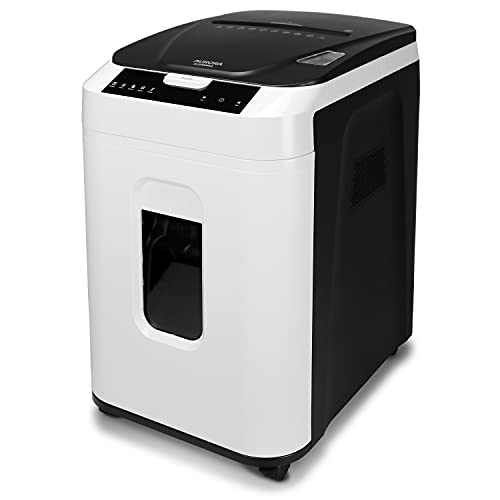
| Aurora Commercial Grade (200/220-Sheet) | Auto feed with long run time | Auto feed, P-5 micro-cut, 60 minutes |
| Basics 200-Sheet Cross-Cut | Cross-cut, mid-size office | 200-sheet auto feed, P-4, 8.5-gallon pullout bin |
| Fellowes Powershred 425Ci | Manual feed, commercial grade | 30-sheet cross-cut, jam proof, TAA compliant |
How to Choose
Understand auto feed versus manual feed
Auto-feed shredders have a tray that holds a stack, often 200 to 400 sheets, and pulls pages in without anyone standing there. That frees up the person who would otherwise feed pages a few at a time. A manual feed slot, like the one on the Fellowes unit, takes a defined number of sheets at once, such as 30. Auto feed is the better answer for large cleanouts, while manual feed fits quick, occasional jobs.
Check the cut type and security level
Cross-cut shredders slice paper into small rectangles, while micro-cut turns it into much smaller particles. Titles list levels such as P-4 or P-5, where a higher number means a finer cut. Confirm the standard on the listing, and match the level to the sensitivity of the paper. Micro-cut machines usually take fewer sheets per pass and produce more waste volume in the bin, so size the bin accordingly.
Look at run time, bin size, and noise
Run time tells how long the motor can work before it needs to cool, with figures like 60 minutes of continuous use in several titles. Bin capacity, such as 8.1, 8.5, or 13.2 gallons, determines how often someone must empty it. A listed noise figure like 58dB is helpful for open offices, though it does not make a shredder silent. Check the listing for any duty cycle limits. A machine that needs a long rest after a short burst will frustrate anyone with a big pile, while one with a longer stated run time and a cool-down policy fits scheduled cleanouts better. Plan the location too: a spot near an outlet, with space around the vents, keeps the motor from running hotter than necessary.
Know what to ignore and where budget machines cut corners
Words like heavy duty and jam-resistant are common, so look for specifics such as auto-reverse and anti-jam features, along with the maker’s guidance on what the machine can cut. Budget machines tend to save on cutter material, bin quality, and thermal protection, which leads to jams and overheating on dense stacks. Never feed items the manual says to avoid, and keep ties, scarves, and fingers away from the feed opening.
The 6 Best Options
Kitnery 400-Sheet Auto Feed Micro Cut Shredder
The Kitnery lists a 400-sheet auto feed, P5 micro cut, nonstop running, a manual feed slot for 8 sheets, and a 13.2 gallon bin. It targets offices with big batches of paper to clear in a single sitting.
- Strength: 400-sheet auto feed is the largest stack capacity in this list
- Strength: 13.2 gallon bin means fewer trips to empty it
- Trade-off: the manual slot takes only 8 sheets, so it is slower for a few loose pages
Skip it if desk or floor space is tight, since a large bin and body take room. It also suits shared offices where several people drop off material for a single scheduled shred session. The jam-resistant wording in the title points to a design aimed at stacks that include a few stray staples, though the manual should be checked for which items the cutters can handle. Because of its size, it is better parked beside a filing area than tucked under a small desk.
BONSEN P-5 High Security 320-Sheet Micro Cut
The BONSEN is a 320-sheet auto feed micro-cut machine at the P-5 level, with a 60 minute non-stop run time and a 58dB noise figure. The title also mentions shredding items such as credit cards and staples. That makes it a candidate for desks where expired cards, mailers, and stapled statements all land in the same pile, although the listing should be read for exact feed limits on cards and thicker items.
- Strength: P-5 micro cut produces very small particles
- Strength: 60 minutes of non-stop running supports long sessions
- Trade-off: micro-cut output fills the bin faster than larger cuts
Skip it if a cross-cut is enough and a lower-priced tier is the goal.
Bonsaii 240-Sheet Auto Feed Micro Cut
This unit lists a 240-sheet auto feed, P4 security, 60-minute nonstop operation, anti-jam protection, 58dB, and an 8.1-gallon bin. It suits small offices that want quieter running and a moderate stack size. A shared break-room corner or a home office near a living area are the sorts of places where the noise figure can make a real difference. The P4 level is a step below the P5 models here, which can be a reasonable fit for general business paper.
- Strength: 58dB figure is aimed at quieter operation
- Strength: anti-jam and 60-minute run time suit steady work
- Trade-off: the 8.1-gallon bin fills sooner than the larger one on the Kitnery
Skip it if the highest security level is needed.
Aurora Commercial Grade Auto Feed Micro-Cut
Aurora offers 200-sheet and 220-sheet auto-feed versions, both described as high-security micro-cut machines at the P-5 level with 60 minutes of run time. It suits offices that want a commercial-grade brand name with a simple stack feature. The two versions share their security level and run time, so the choice often comes down to how much paper is loaded at once. A smaller team that shreds a few folders each week could be well served by either, as long as the bin size on the listing suits the volume.
- Strength: P-5 micro-cut security level listed
- Strength: 60-minute run time for longer sessions
- Trade-off: sheet capacity differs between the two versions, so the listing should be read closely
Skip it if a bigger stack than 220 sheets is needed.
Basics 200-Sheet Auto Feed Cross-Cut Shredder
This black cross-cut unit lists a 200-sheet auto feed, P-4 high security, anti-jam, and an 8.5-gallon pullout bin. It suits mid-size offices that prefer cross-cut and an easy-to-empty bin. A pullout bin matters more than it sounds, because bins that are fiddly to remove tend to be emptied late, and an overfull bin is a common cause of stoppages. Anti-jam is also listed, which is designed to help the machine back out when a feed gets too thick.
- Strength: pullout bin simplifies emptying
- Strength: cross-cut is a familiar style that suits general office paper
- Trade-off: the title does not list a run time, so duty cycles need checking
Skip it if the work involves large daily volumes.
Fellowes Powershred 425Ci
This commercial-grade manual-feed shredder lists a 30-sheet cross-cut capacity, a 100 percent jam proof claim, and TAA compliance. It is aimed at offices that prefer a long-established office brand. The jam-proof wording in the title is a marketing claim, so buyers should read the product details for what it covers. A manual-feed machine can be a good fit for an executive office or a reception area where someone shreds a handful of pages and walks away.
- Strength: 30-sheet manual capacity handles stacks without an auto feed tray
- Strength: TAA compliance may matter for some purchasing rules
- Trade-off: manual feeding needs someone standing by
Skip it if unattended shredding of large piles is the goal.
Which One Fits Your Situation
An annual records cleanout
The Kitnery 400-sheet auto feed with a 13.2 gallon bin suits large batches with minimal attention.
An open office where noise matters
The Bonsaii or BONSEN list a 58dB figure, which suits shared spaces better than an unspecified model.
A legal or finance office that handles sensitive pages
The BONSEN P-5 or Aurora P-5 micro-cut options offer the finest cut level among these.
A purchasing team with compliance rules
The Fellowes Powershred 425Ci lists TAA compliance, which may satisfy specific procurement requirements.
A mid-size office that wants a pullout bin and cross-cut
The Basics 200-sheet cross-cut shredder pairs an auto feed with an 8.5-gallon pullout bin, which keeps the daily routine simple for whoever is assigned to empty it.
Common Mistakes
- Choosing by sheet capacity alone and ignoring run time and cooling.
- Feeding more sheets than the title lists, which causes jams.
- Forgetting to remove metal clips or large staples when the manual says to.
- Letting the bin overflow, which can trigger shutoffs or spills.
- Assuming a P rating alone makes a document handling process secure.
Related guides
- Affordable Gaming Mouse For Alienware Laptop
- Laptop Docking Stations For Dual Monitors
- Travel Backpack With Laptop Compartment
Frequently Asked Questions
What is the difference between cross-cut and micro-cut?
Cross-cut makes small rectangles, while micro-cut makes even smaller particles. Micro-cut is generally chosen for sensitive paper, while cross-cut often handles everyday office paper with a bit more capacity per pass. Matching the cut to the content is more useful than simply buying the finest option available.
Can these shredders handle credit cards?
Some titles mention cards or staples, and others do not. Check the listing for what each machine can feed.
Do shredders need oil?
Some models call for lubrication and others do not. Follow the manufacturer’s directions in the manual. Using the wrong lubricant, or none when one is required, can shorten the life of the cutters, so it is worth reading that section before the first big batch.
How long can they run?
Several list 60 minutes of continuous use, followed by a cool-down. Confirm the exact duty cycle on the listing. Pushing a machine to keep running after it signals overheating shortens its life, so a pause to let it cool is part of normal use for any office shredder.
More from Amazon
Programs that pair well with the guide above. Offers and eligibility are set by Amazon and may change.
A free business account with business pricing and bulk-buying tools for work, shop or home office.
Create a business accountFree shipping on eligible items, Prime Video and more. Eligible new members can start with a free trial.
Start a Prime free trialAudiobooks and podcasts to listen to on the go. Eligible new members can start with a free trial.
Try Audible freeAd-free music streaming. Eligible new subscribers can start with a free trial.
Try Music Unlimited freeAs an Amazon Associate we earn from qualifying purchases.


Write Your Review
No reviews yet. Be the first to share your experience!