

Key takeaways
- A stack of loose pages looks unfinished. Run the same pages through a binding machine and they become a report, a training manual, a recipe book.
A stack of loose pages looks unfinished. Run the same pages through a binding machine and they become a report, a training manual, a recipe book, or a client proposal that lies flat and opens cleanly. The decision starts with the binding style, since comb, wire, and coil systems each use different hole patterns, supplies, and punching mechanics. A buyer who picks the machine before the binding style often ends up with supplies that do not match the punch.
This guide is for teachers, home offices, small businesses, and print-and-bind hobbyists who want to choose among comb, wire, and coil machines. The 2026 shortlist below covers manual punches and electric models, and every spec comes from the product titles, such as punch capacity, binding capacity, and hole count. Confirm paper size, binding supply sizes, and the real-world thickness limit on the listing before ordering, because supplies sold separately are often where the ongoing cost sits.
Quick Picks
Our top picks


As an Amazon Associate we earn from qualifying purchases at no extra cost to you.
| Product | Best for | Key spec from the title |
|---|---|---|
| MAKEASY Comb Binding Machine | Starter comb binding at home or school | 12-sheet punch, 100 combs, Letter/A4/A5 |
| RAYSON TD-132 Wire Binding Machine | Polished wire-bound documents | 3:1 pitch, 12-sheet punch, 120-sheet capacity, 32 holes |
| Fellowes Pulsar+ Comb Binder | Classroom and office use | 20-sheet punch, 10-pack starter kit |
| VEVOR Coil Spiral Binding Machine | Thick books with coil | 46 holes, 500 sheets, 100 coils |
| TruBind Coil Binding Machine | Coil with an electric inserter | 20-sheet punch, up to 440 sheets, 46 disengageable dies |
| Fellowes Quasar 500 Electric Comb Binder | High-volume comb binding | 20-sheet electric punch, starter kit |
How to Choose
Pick the binding style first
Comb binding uses plastic spines that can be opened and reused, which suits documents that change. Wire binding, often called twin loop, looks more polished and holds pages in a rigid arrangement, so it is common for reports and calendars. Coil binding, also called spiral, lets pages rotate fully and lie flat, making it a favorite for notebooks and cookbooks. Each style needs its own supplies, so the machine decision and the supply decision are the same decision.
Compare punch capacity and binding capacity
Punch capacity is how many sheets the machine punches in a single pull or press, such as 12 or 20. Binding capacity is the thickest document the spine can hold, such as 120, 350, 440, or 500 sheets. A 12-sheet punch means a 100-page book needs about nine batches, while a 20-sheet punch cuts the time. If volumes are high, an electric punch lowers hand fatigue, but it adds cost and needs a power outlet.
Check paper sizes and hole patterns
Letter, A4, and A5 are common sizes, but hole counts differ by size, such as 19 holes for Letter and 21 for A4 in comb systems. A machine listing a 32-hole Letter pattern or a 46-hole pattern signals a wire or coil layout. Adjustable side margins help center the holes on pages with different widths. Confirm that the supplies listed match the machine, since mismatched pitch is a leading reason for returns.
Know what to ignore and where budget machines cut corners
Extras like starter kits are handy, but they run out quickly, so factor in refill costs. Budget models can use thinner punch dies, plastic handles, and weak margin guides, which leads to misaligned holes or jams on thick stacks. Metal-body machines with replaceable or disengageable dies tend to handle heavier use. Never force a punch past its stated sheet limit, and keep fingers clear of the die area.
The 6 Best Options
MAKEASY Comb Binding Machine
This starter machine combines a 12-sheet punch with 100 combs in the box and a heavy-duty metal build. The title says it fits Letter, A4, and A5 paper, which makes it flexible for a mix of document sizes.
- Strength: 100 combs are included, so binding can start right away
- Strength: supports Letter, A4, and A5 paper
- Trade-off: the 12-sheet punch means more passes on thick documents
Skip it if a high volume of thick documents is expected. It suits a home office or classroom that binds a few projects a week, and the metal build is described as aimed at jam-free punching, though real-world results depend on paper stock and technique. Because the same machine handles Letter and A5, it also works for people who print small booklets, such as event programs or study guides, alongside full-size reports, without buying a second punch for each format.
RAYSON TD-132 3:1 Wire Binding Machine
This wire binder offers a 12-sheet punch and a 120-sheet capacity, with 32-hole Letter-size punching and margins of 2.5, 3.5, and 4.5 mm. The 3:1 pitch is the style associated with a neat, professional twin-loop finish.
- Strength: 32-hole Letter pattern gives a polished look
- Strength: multiple margin settings help center the holes
- Trade-off: wire supplies and closing steps take more effort than comb
Skip it if frequent edits to bound documents are expected, since wire is harder to reopen than comb. It suits reports, presentations, and proposals that need a refined finish. The 120-sheet limit in the title is a clear figure to compare against the thickest document planned, and the choice of side margins is a nice touch for pages that have text close to the left edge.
Fellowes Pulsar+ Comb Binding Machine
This manual comb binder has a 20-sheet punch capacity and a 10-pack starter kit, aimed at school supplies and classroom organization. It suits teachers and small offices who want more punching power per pull than basic units.
- Strength: 20-sheet punch cuts down the number of passes
- Strength: starter kit is included for immediate use
- Trade-off: a manual handle still requires effort on thick stacks
Skip it if an electric punch is wanted for heavy volume. A familiar office brand name helps buyers find replacement combs later. Teachers who bind student portfolios at the end of a term can set up a quick punch-and-bind routine with this style, and the 10-pack starter kit covers a first small batch before a refill order is needed.
VEVOR Coil Spiral Binding Machine
The VEVOR is a manual book maker with electric binding, listing 46 holes, a 500-sheet figure, and 100 pieces of 5/16 inch coil. It targets makers who want thick, flat-opening books such as cookbooks or manuals.
- Strength: 46-hole coil pattern and 500-sheet limit suit thicker projects
- Strength: 100 coils are included in the package
- Trade-off: coil needs crimping or inserting, which takes practice
Skip it if documents are thin or if comb is preferred. The 5/16 inch coil is a small size, so thicker books need larger coil. The title mixes manual punching with electric binding, so the listing should be read to understand which step is powered. Buyers planning a recipe collection or a family history book can use the coil to let the pages fold back on themselves and lie flat on a counter.
TruBind Coil Binding Machine with Electric Coil Inserter
This coil system has an electric coil inserter, adjustable side margin, a 20-sheet punch capacity, 46 fully disengageable dies, and binding for up to 440 sheets. It suits small shops and schools that bind coil documents regularly. The adjustable side margin makes it easier to keep the holes centered on stock of different widths, and disengageable dies are designed to let the user turn off punch pins for shorter pages. That flexibility is useful in a print shop that handles different jobs every week.
- Strength: electric inserter speeds up the coil step
- Strength: disengageable dies allow different page sizes and sheet counts
- Trade-off: more features mean a higher cost tier and a bigger footprint
Skip it if only a few documents are bound each year. The machine also needs desk space for both the punch and the inserter, so a permanent work table is a better home than a shelf that must be cleared each time.
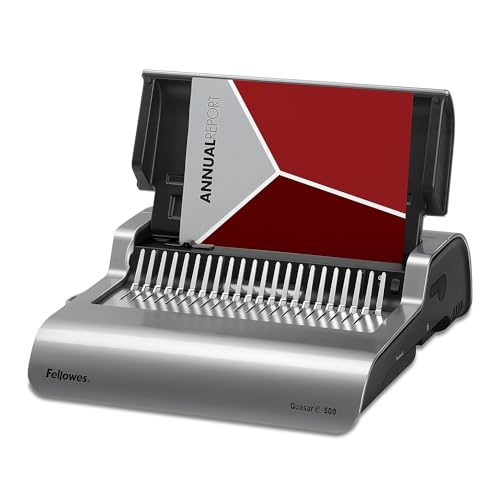
Fellowes Quasar 500 Electric Comb Binding Machine
This heavy-duty electric comb binder has a 20-sheet electric punch and a starter kit. It is aimed at classrooms and offices that bind often and want to skip the hand cranking. A busy front office that produces handouts or training packets on a regular schedule is the typical buyer, and the comb format means the spines can be opened later when a page needs to be swapped or added.
- Strength: electric punching reduces hand strain
- Strength: starter kit gets users binding right away
- Trade-off: requires an outlet and a permanent spot on a desk or cart
Skip it if the machine will be moved between rooms or used only rarely. Electric units also benefit from a stable surface and a clear path for scrap chips, which collect in a tray that should be emptied regularly according to the manufacturer’s directions.
Which One Fits Your Situation
A teacher binding class projects each month
The Fellowes Pulsar+ offers a 20-sheet manual punch and a starter kit that fits a classroom budget tier.
A small agency producing client proposals
The RAYSON TD-132 wire binder provides a polished twin-loop look and clear margin options.
A hobbyist making cookbooks and manuals
The VEVOR or TruBind coil machines are well suited, because coil lies flat and handles thicker stacks.
A busy office binding every week
The Fellowes Quasar 500 saves effort with an electric punch, and the MAKEASY works as an affordable backup unit.
A first-time buyer with a tight budget tier
The MAKEASY gives the lowest-risk entry, because the combs are included and the punch is simple. It also helps to buy a small pack of extra spines in a couple of sizes so thin and thick documents can both be bound.
Common Mistakes
- Buying a machine before deciding on comb, wire, or coil.
- Overloading the punch beyond its listed sheet limit.
- Ignoring supply costs for combs, wires, or coils.
- Mismatching the spine size to the thickness of the document.
- Skipping a test punch on scrap paper before using final pages.
Related guides
- Affordable Gaming Mouse For Alienware Laptop
- Laptop Docking Stations For Dual Monitors
- Travel Backpack With Laptop Compartment
Frequently Asked Questions
Which binding style is easiest to start with?
Comb binding is usually the simplest, because spines open and close by hand. Wire and coil look more finished but need extra steps, such as closing the wire with a crimping tool or feeding the coil through the holes, so budget a little practice time with scrap paper.
How many pages can a binder hold?
That depends on the spine size and machine. Titles list capacities such as 120, 440, or 500 sheets, and the supplies determine the real limit.
Can one machine bind several paper sizes?
Some can, such as those listing Letter, A4, and A5. Check the listing for supported sizes and hole patterns.
Are electric binders worth it?
For frequent, high-volume binding, they save effort. For occasional use, a manual machine is usually enough. Many offices start with a manual comb binder and move to an electric model only when the monthly page count makes hand punching tedious.
More from Amazon
Programs that pair well with the guide above. Offers and eligibility are set by Amazon and may change.
A free business account with business pricing and bulk-buying tools for work, shop or home office.
Create a business accountFree shipping on eligible items, Prime Video and more. Eligible new members can start with a free trial.
Start a Prime free trialAudiobooks and podcasts to listen to on the go. Eligible new members can start with a free trial.
Try Audible freeAd-free music streaming. Eligible new subscribers can start with a free trial.
Try Music Unlimited freeAs an Amazon Associate we earn from qualifying purchases.



Write Your Review
No reviews yet. Be the first to share your experience!