
Parkasaurus asks very little of a laptop on paper, and that shapes the real decision here. Washbear Studio publishes a light line: a dual-core processor at minimum, 4 GB of memory, and a discrete graphics card with 1 GB of graphics memory. The genuine choice is screen size, because a growing dinosaur park spreads across wide exhibits, paths and guest areas, and a bigger, sharper panel keeps more of that layout in view at once. Memory headroom matters too, since the recommended line doubles the minimum figure to 8 GB.
This guide serves three groups: players buying their first gaming laptop mainly for relaxed builders like this one, families sharing one machine between schoolwork and park sessions, and long-time players who want a second, lighter laptop for the sofa. Every pick below comes from the names and figures printed on its product listing, matched against the published requirements, so the comparison rests on stated hardware rather than marketing labels.
Quick Picks
As an Amazon Associate we earn from qualifying purchases
| Product | Best for | Key spec from title |
|---|---|---|
| HP Victus 15 | A first gaming laptop that also covers heavier games | RTX 5060 with 32 GB DDR5 RAM |
| Lenovo Legion 5 Gen 10 | The sharpest screen for reading a busy park layout | 15.1-inch WQXGA OLED, 500 nits |
| Acer Nitro V 15 | A strong processor for big late-game parks | Intel Core i9-13900H with RTX 4060 |
| MSI Katana 15 | A straightforward 15.6-inch option with 1 TB storage | RTX 4050 with 1 TB NVMe SSD |
| ASUS Zenbook 14 OLED | Carrying the game between rooms and trips | Ryzen 7 8840HS with Radeon 780M |
How to Choose
Platform and the Published Requirements
Parkasaurus is a Windows-only release as published. Its Steam page (app 591460) prints one Windows block and no macOS or Linux block, so there is no Mac edition. The minimum line asks for Windows 7 SP1, Windows 8 or Windows 10, 64-bit only, an X64 dual-core processor at 2 GHz or more, 4 GB of memory, a discrete non-mobile graphics card with 1 GB of graphics memory, DirectX 11 and 3 GB of storage. The recommended line raises the processor to a quad-core at 3 GHz, memory to 8 GB and the graphics card to 2 GB. Steam notes its client supports only Windows 10 and later since January 2024.
Processor and Memory Against the Published Line
The published processor line is modest: a dual-core chip at 2 GHz meets the minimum, and a quad-core at 3 GHz meets the recommended tier. Every laptop in this guide lists an eight-core processor, from the Victus and Zenbook’s Ryzen AI 7 350 and Ryzen 7 8840HS to the Nitro’s Core i9-13900H, so each one clears the recommended core count on paper. Memory follows the same pattern. The game asks for 4 GB at minimum and 8 GB recommended, while the five listings carry 16 GB or 32 GB of DDR5 memory. The Nitro lists two memory slots with a 32 GB maximum, and the Legion lists a 32 GB maximum as well.
Storage Against the Published Line
Storage is the easiest check on the page. Parkasaurus needs 3 GB of available space, and every pick here lists an SSD many times that size: 1 TB in the Victus, Legion, Nitro and Katana, and 512 GB in the Zenbook. The listings describe those drives in their own words — the Nitro names a 1 TB PCIe Gen 4 SSD with two M.2 slots, the Legion a 1 TB SSD M.2 2242 PCIe Gen4, and the Zenbook a 512 GB M.2 NVMe PCIe 4.0 SSD. None of the five comes close to tight on room, so storage should only decide between these machines if you also keep a large library of other games installed.
Screen Size, Resolution and Weight
Screen size is where these five separate. The Victus, Nitro and Katana each list a 15.6-inch Full HD panel, at 144Hz on the Victus and Katana and 180Hz on the Nitro. The Legion lists a 15.1-inch WQXGA OLED at 2560×1600 and 500 nits, the sharpest figure here for reading a crowded park. The Zenbook lists a smaller 14-inch OLED at 1920×1200 with touch, and it is the lightest at about 2.65 pounds, against 4.96 pounds for the Katana. Where lower-end machines cut back, it is usually here: dimmer 60Hz panels, lower resolution and heavier plastic bodies.
The 5 Best Options
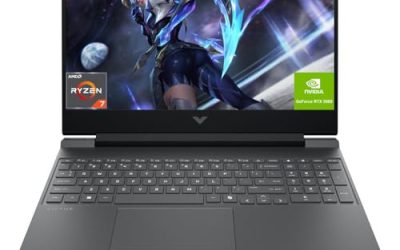
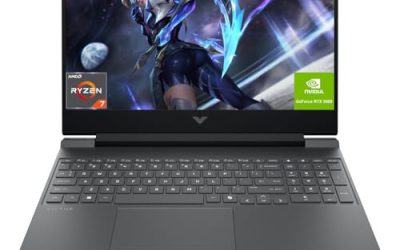
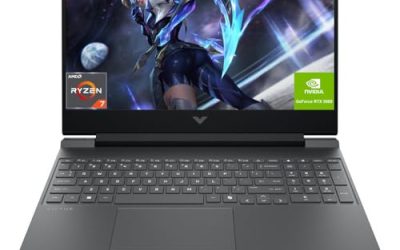
HP Victus 15
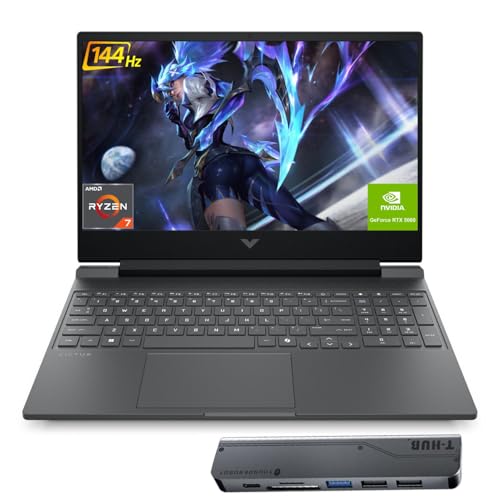
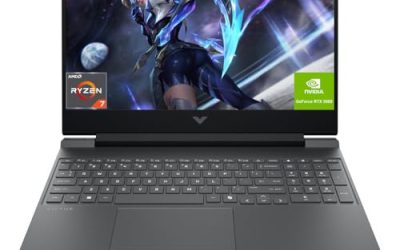
Buyers who want one laptop for Parkasaurus and a shelf of heavier games get the most headroom here. The listing pairs a Ryzen AI 7 350, listed at up to 5.0 GHz, with a dedicated RTX 5060 and 32 GB of DDR5 memory, which is four times the game’s recommended 8 GB figure. The 15.6-inch Full HD screen at 144Hz gives a wide park layout room to breathe, and the 1 TB SSD swallows the game’s 3 GB install many times over. The bundle even adds a Thunderobot 7-in-1 USB-C hub in the box, as listed.
Specs
- Processor: AMD Ryzen AI 7 350, up to 5.0 GHz as listed
- Graphics: NVIDIA GeForce RTX 5060, dedicated
- Memory: 32 GB DDR5 RAM at 4800 MHz
- Storage: 1 TB SSD, PCIe x4 interface
- Display: 15.6-inch, 1920×1080, 144Hz as listed
- Keyboard: RGB backlit, with RJ-45 Ethernet port
- Extras: Thunderobot 7-in-1 USB-C hub bundled as listed
- Operating system: Windows 11 Home
- Series: HP TPN-Q279, Black
Best for: A first gaming laptop that covers Parkasaurus plus heavier games.
Watch out for: The listing’s specification table does not print the RTX 5060’s graphics memory figure, so confirm it on the page before ordering if that number matters to you.
ASIN: B0G1N8R9Z4
Lenovo Legion 5 Gen 10

Players who spend long sessions reading a dense park — tiny paths, fences and guest facilities — benefit most from this screen. The listing names a 15.1-inch WQXGA OLED panel at 2560×1600 and 500 nits, non-touch, the highest resolution in this guide. Behind it sit a Ryzen 7 260 running 3.80 to 5.10 GHz, an RTX 5060 with 8 GB of GDDR7 memory, 16 GB of DDR5-5600 memory and a 1 TB SSD, each figure far past the published recommended line. The 24-zone RGB backlit keyboard and USB4 port round out a machine aimed well beyond one light builder.
Specs
- Processor: AMD Ryzen 7 260, 3.80 GHz up to 5.10 GHz
- Graphics: NVIDIA GeForce RTX 5060 Laptop GPU, 8 GB GDDR7
- Memory: 16 GB DDR5-5600 SODIMM, 32 GB maximum as listed
- Storage: 1 TB SSD M.2 2242 PCIe Gen4 TLC
- Display: 15.1-inch WQXGA OLED, 2560×1600, 500 nits, non-touch, 165Hz as listed
- Ports: USB4 40Gbps, USB-C 10Gbps, HDMI 2.1, Ethernet RJ-45, headphone/microphone combo jack
- Keyboard: 24-zone RGB backlit
- Operating system: Windows 11 Home
Best for: Long sessions where a sharp, bright screen matters most.
Watch out for: The listing prints an item weight of 7.09 pounds, which reads high for this class, so check the current figure on the page before ordering.
ASIN: B0FXMY8FYW
Acer Nitro V 15

The Nitro suits players who like keeping many browser tabs, a chat app and the game open together, and who may push into larger parks. Its listing leads with a 13th Gen Intel Core i9-13900H, well past the recommended quad-core line, plus an RTX 4060 with DLSS 3.5 and 16 GB of DDR5 memory in two slots, expandable to 32 GB as listed. The 15.6-inch Full HD IPS panel runs at 180Hz, the highest refresh figure here, and the 1 TB Gen 4 SSD sits in one of two M.2 slots, leaving the second free.
Specs
- Processor: Intel Core i9-13900H, 13th Gen
- Graphics: NVIDIA GeForce RTX 4060 Laptop GPU with DLSS 3.5
- Memory: 16 GB DDR5, two slots, 32 GB maximum as listed
- Storage: 1 TB PCIe Gen 4 SSD, two M.2 slots as listed
- Display: 15.6-inch FHD IPS, 180Hz as listed
- Connectivity: Thunderbolt 4, Wi-Fi 6, Ethernet RJ-45, HDMI 2.1
- Cooling: dual fans as listed
- Keyboard: backlit
- Operating system: Windows 11 Home
Best for: Players who multitask heavily around long park sessions.
Watch out for: The listing does not print the RTX 4060’s graphics memory figure in its specification area, so confirm it on the page before ordering.
ASIN: B0D8JTYXQM
MSI Katana 15

The Katana is the straightforward middle path: a 15.6-inch Full HD IPS screen at 144Hz, an Intel Core i7-13620H and an RTX 4050 with 6 GB of GDDR6 memory, which clears the recommended 2 GB graphics figure three times over on paper. Its 16 GB of DDR5-4800 memory doubles the recommended 8 GB, and the 1 TB NVMe SSD leaves generous room beside the game’s 3 GB. At 4.96 pounds as listed, it is lighter than many gaming laptops, and the black chassis keeps the look plain for shared family use.
Specs
- Processor: Intel Core i7-13620H, 13th Gen
- Graphics: NVIDIA GeForce RTX 4050, 6 GB GDDR6 per the listing’s bullet text
- Memory: 16 GB DDR5-4800 RAM
- Storage: 1 TB NVMe SSD
- Display: 15.6-inch Full HD IPS, 144Hz
- Ports: USB Type-C as listed, Ethernet, HDMI
- Weight: 4.96 lbs (2.25 kg) as listed
- Operating system: Windows 11 Home, Black
Best for: A plain, capable 15.6-inch laptop for park building and everyday use.
Watch out for: The listing’s technical-details table prints a graphics memory figure that conflicts with the 6 GB GDDR6 in its own bullet text, so read both before ordering.
ASIN: B0BZBN3857
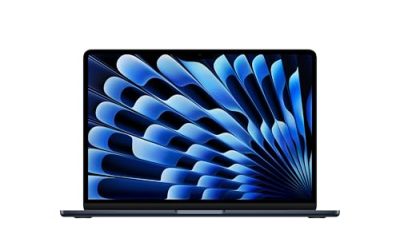
ASUS Zenbook 14 OLED

Portability leads here. The Zenbook lists a 14-inch WUXGA OLED touchscreen at 1920×1200, a Ryzen 7 8840HS, 16 GB of LPDDR5X memory and a 512 GB SSD, in a Jade Black body of about 2.65 pounds with a 75 Wh battery listed at up to 17 hours. One honesty point matters: its Radeon 780M graphics are integrated, and the published line names a discrete non-mobile graphics card, so this pick sits outside that wording. It fits buyers who value the light body and rich screen for a light builder, played at modest settings.
Specs
- Processor: AMD Ryzen 7 8840HS, up to 5.1 GHz as listed
- Graphics: AMD Radeon 780M, integrated, 12 RDNA 3 compute units as listed
- Memory: 16 GB LPDDR5X
- Storage: 512 GB M.2 NVMe PCIe 4.0 SSD
- Display: 14-inch WUXGA OLED touchscreen, 1920×1200, 500-nit peak HDR, 100% DCI-P3 as listed
- Battery: 75 Wh, up to 17 hours as listed
- Connectivity: Wi-Fi 6E, USB4 Type-C, HDMI 2.1, 3.5mm combo audio jack
- Weight: about 2.65 lbs as listed, Jade Black
- Operating system: Windows 11 Home
Best for: Playing on the sofa, in bed or while travelling light.
Watch out for: The listing describes a touchscreen while the maker’s spec sheet for UM3406HA lists a non-touch panel, so confirm the panel on the page before ordering; its integrated graphics also sit outside the published discrete-card wording.
ASIN: B0DFWZ77LB
Which One Fits Your Situation
Your First Gaming Laptop, Bought Mainly for Builders
If this is your first gaming laptop and relaxed builders are the main event, the HP Victus 15 is the safest fit. Its 32 GB of memory is four times the recommended figure, its 1 TB SSD leaves room for a growing library, and the dedicated RTX 5060 means the same machine stays useful when you move on to heavier games later. The bundled USB-C hub also helps a tidy desk setup.
Long Sessions Reading a Crowded Park
For marathon sessions in a mature park full of tiny details, the Lenovo Legion 5 Gen 10 fits best. Its 15.1-inch OLED panel at 2560×1600 and 500 nits keeps paths, fences and signs legible without constant zooming, and the 16 GB of memory doubles the recommended figure. The RTX 5060 with 8 GB of GDDR7 also gives the machine a long useful life beyond this one game.
A Family Machine That Moves Around the House
When one laptop is shared between homework, browsing and evening park sessions, the MSI Katana 15 is the balanced fit. The 15.6-inch screen is big enough for a wide park view, the 16 GB of memory handles school and browser work alongside the game, and the 4.96-pound weight as listed is manageable between rooms. Its plain black design also suits a shared machine better than flashier gaming styles.
Playing Light on the Sofa or Away from Home
If the laptop travels in a backpack or lives on the sofa, the ASUS Zenbook 14 OLED is the fit, at about 2.65 pounds with a 75 Wh battery listed at up to 17 hours. Its OLED screen flatters the game’s colours, and 16 GB of memory clears the recommended line. Accept the trade plainly: its integrated graphics sit outside the published discrete-card wording, so keep settings modest.
Common Mistakes
- Buying a Mac for this game: Parkasaurus publishes Windows requirements only, with no macOS block, so a Mac cannot run the native edition.
- Assuming integrated graphics match the published line: the requirements name a discrete non-mobile card, so treat integrated-graphics laptops as outside that wording.
- Skipping the memory check: the recommended line asks for 8 GB, double the minimum, so a 4 GB machine sits below the tier the publisher points to.
- Ignoring screen size on a wide park view: small, dim panels make paths and exhibit details harder to read in a mature park.
- Trusting one spec table blindly: listings sometimes conflict with themselves, so re-read the full page before ordering.
Frequently Asked Questions
Can I play Parkasaurus on a Mac?
No native Mac edition is published. The Steam page for Parkasaurus (app 591460) prints a single Windows requirements block covering Windows 7 SP1, Windows 8 and Windows 10 in 64-bit form, and no macOS or Linux block appears. Steam also notes its client supports only Windows 10 and later from January 2024, so plan on a Windows laptop from this guide.
How much memory does Parkasaurus need?
The published minimum is 4 GB and the recommended figure is 8 GB. Every laptop in this guide lists 16 GB or 32 GB of DDR5 memory, so each clears the recommended line with room to spare for a browser, chat app or guide page open beside the game. The Nitro and Legion also list 32 GB maximums for later memory upgrades.
Does Parkasaurus need a dedicated graphics card?
The published line says yes in its own wording: the minimum names a discrete non-mobile GPU with 1 GB of graphics memory, and the recommended tier raises that to 2 GB. Four picks here carry dedicated RTX cards. The Zenbook’s integrated Radeon 780M sits outside that wording, and the article frames it honestly as the portability pick for modest settings.
How much storage space should I leave for Parkasaurus?
The published requirement is 3 GB of available space, which is tiny beside the drives listed here: 1 TB SSDs in four picks and a 512 GB SSD in the Zenbook. Storage only becomes a deciding point if you keep many large games installed at once; for this game alone, every machine in the guide has room many times over.
More from Amazon
Programs that pair well with the guide above. Offers and eligibility are set by Amazon and may change.
A free business account with business pricing and bulk-buying tools for work, shop or home office.
Create a business accountFree shipping on eligible items, Prime Video and more. Eligible new members can start with a free trial.
Start a Prime free trialAudiobooks and podcasts to listen to on the go. Eligible new members can start with a free trial.
Try Audible freeAd-free music streaming. Eligible new subscribers can start with a free trial.
Try Music Unlimited freeAs an Amazon Associate we earn from qualifying purchases.
Write Your Review
No reviews yet. Be the first to share your experience!