
Key takeaways
- Compare the best laptops for Bomb Rush Cyberfunk with verified picks matched to the game's published PC requirements and display checks inside.
Bomb Rush Cyberfunk, from Team Reptile, sends a graffiti crew across the city of New Amsterdam on skates, bikes, and boards, chaining tricks and tagging walls. It is a fast, bright, movement-driven game with a small published hardware ask: its minimum block names hardware from well over a decade ago. Almost any current gaming laptop clears that bar, so the real decision is the screen, the ports, and headroom for the rest of your library.
As an Amazon Associate, we earn from qualifying purchases.
This guide lines up five Windows laptops: four with dedicated graphics, plus one slim OLED ultrabook for players who travel light. Every pick is matched against the requirements the publisher prints.
How to Choose a Laptop for Bomb Rush Cyberfunk
Start with the platform fact: Bomb Rush Cyberfunk is Windows-only on PC. Its Steam store page (app 1353230) publishes a single Windows requirements block, with no macOS edition and no Linux edition, so Mac owners should not expect a native version of the game.
The published minimum block is modest: Windows 7, an Intel Core i3 at 2.5 GHz or an AMD Phenom at 2.5 GHz, 4 GB of RAM, an NVIDIA GeForce GTX 460 or an ATI Radeon HD 5850, and 2 GB of storage. One footnote: the Steam client itself has supported only Windows 10 and later since January 2024, so a Windows 11 machine is the sensible baseline. The sound card line even reads “Naganuma compatible,” a nod to the composer.
Graphics is the one line worth reading carefully. The publisher’s notes add that Intel onboard video is not recommended, which points buyers toward a dedicated graphics card. Four of the five picks below carry one. The fifth uses modern integrated Radeon graphics, framed honestly in its section: it sits below the dedicated cards here, even though the minimum card is old and undemanding.
After that, choose on the screen. The game is built on bold cel-shaded color and constant motion, so panel quality matters more than raw power: a 144 Hz screen suits the movement, and OLED shows the saturated art at its best. Storage is a non-issue at 2 GB; every pick below carries at least 512 GB.
HP Victus 15
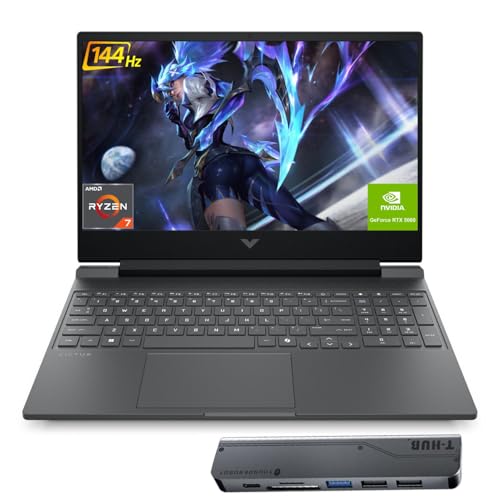
The Victus 15 is the straightforward recommendation, with hardware far above the published minimum on every line. Its Ryzen AI 7 350 and dedicated RTX 5060 graphics clear the GTX 460 minimum by a wide margin, and its 32 GB of memory is eight times the 4 GB the publisher asks for. It also suits a wider library.
The 15.6-inch Full HD screen refreshes at 144 Hz, a good match for constant motion, and the RGB backlit keyboard includes a numeric keypad for everyday work. Wired networking is built in via RJ-45, and the listing bundles a Thunderobot 7-in-1 USB-C hub, handy when a controller, headset, and external drives all need a home.
Specs
- CPU: AMD Ryzen AI 7 350, up to 5.0 GHz as listed
- GPU: NVIDIA GeForce RTX 5060, 8GB GDDR7, dedicated
- Memory: 32GB DDR5
- Storage: 1TB SSD
- Display: 15.6-inch FHD 144Hz
- Keyboard: RGB backlit with numeric keypad
- Ports: RJ-45 Ethernet; bundled Thunderobot 7-in-1 USB-C hub as listed
- OS: Windows 11 Home
- Color: Black, model TPN-Q279
Lenovo Legion 5 Gen 10

The Legion 5 Gen 10 is the pick for players who care most about the picture. Its 15.1-inch OLED panel runs at 2560×1600 with a 165 Hz refresh, so the game’s saturated colors and sharp outlines land on the best screen here. The Ryzen 7 260 and RTX 5060 laptop GPU give it the same comfortable headroom as the Victus, with dedicated graphics answering the publisher’s onboard-video note.
Port selection is a strength: the listing names USB4, HDMI 2.1, and Ethernet RJ-45, so a monitor and a wired connection are both easy. The 24-zone RGB backlit keyboard suits long sessions, and the 1 TB SSD holds the 2 GB install many times over.
Specs
- CPU: AMD Ryzen 7 260, up to 5.1 GHz
- GPU: NVIDIA GeForce RTX 5060 Laptop GPU, 8GB GDDR7
- Memory: 16GB DDR5-5600
- Storage: 1TB SSD M.2 PCIe Gen4
- Display: 15.1-inch WQXGA OLED 2560×1600, 165Hz, 500 nits as listed
- Keyboard: 24-zone RGB backlit
- Ports: USB4, HDMI 2.1, Ethernet RJ-45
- OS: Windows 11 Home
Acer Nitro V 15

The Nitro V 15 (ANV15-51-99XD) brings the strongest processor here, an Intel Core i9-13900H, paired with an RTX 4060 laptop GPU. Against a minimum block naming a Core i3 and a GTX 460, that is generous headroom, and the 180 Hz Full HD IPS panel gives the movement a fast screen. It suits buyers whose laptop also handles heavier games and multitasking.
Upgrade room is part of the appeal: the listing describes 16 GB of DDR5 in two slots, up to 32 GB, and two M.2 slots around the 1 TB Gen 4 SSD. Thunderbolt 4, HDMI 2.1, and Ethernet are all present, and at 4.66 lbs as listed it stays easy to carry.
Specs
- CPU: Intel Core i9-13900H
- GPU: NVIDIA GeForce RTX 4060 Laptop GPU
- Memory: 16GB DDR5 in two slots, up to 32GB as listed
- Storage: 1TB PCIe Gen 4 SSD, two M.2 slots
- Display: 15.6-inch FHD IPS 180Hz as listed
- Ports: Thunderbolt 4, HDMI 2.1, Ethernet RJ-45, Wi-Fi 6
- Keyboard: backlit
- Weight: 4.66 lbs as listed
- OS: Windows 11 Home
MSI Katana 15

The Katana 15 (B13VEK-277US) covers the essentials with a Core i7-13620H and an RTX 4050 with 6 GB of GDDR6 memory. That dedicated card is the important part: it answers the publisher’s guidance against onboard video and sits far beyond the GTX 460 line in the minimum block. The 144 Hz Full HD IPS display keeps motion clear.
Memory is 16 GB of DDR5-4800, four times the published minimum, and the 1 TB NVMe SSD dwarfs the 2 GB install. At 2.25 kg as listed it is a full-size gaming laptop rather than a travel machine, but a well-rounded way to play this game and plenty of others.
Specs
- CPU: Intel Core i7-13620H
- GPU: NVIDIA GeForce RTX 4050, 6GB GDDR6
- Memory: 16GB DDR5-4800
- Storage: 1TB NVMe SSD
- Display: 15.6-inch Full HD IPS 144Hz as listed
- Ports: USB Type-C as listed
- Weight: 2.25 kg as listed
- OS: Windows 11 Home, Black
ASUS Zenbook 14 OLED

The Zenbook 14 OLED is the honest exception here, for players who put portability first. At about 2.65 lbs as listed, with a 14-inch OLED touchscreen and a 75Wh battery, it is the machine you carry all day and play on in the evening. Its Ryzen 7 8840HS is strong, and its 512 GB SSD and 16 GB of memory clear the minimums easily.
The graphics framing needs to be plain: the Radeon 780M is integrated graphics, below the dedicated cards in the four machines above. The publisher’s notes say Intel onboard video is not recommended; the 780M is a modern AMD design rather than an old Intel one, but buyers who want to follow that guidance to the letter should choose a dedicated-graphics machine instead.
Specs
- CPU: AMD Ryzen 7 8840HS, up to 5.1 GHz as listed
- GPU: AMD Radeon 780M integrated
- Memory: 16GB LPDDR5X
- Storage: 512GB M.2 NVMe PCIe 4.0 SSD
- Display: 14-inch WUXGA OLED touchscreen, 1920×1200
- Wireless: Wi-Fi 6E, Bluetooth 5.3 as listed
- Battery: 75Wh
- Weight: about 2.65 lbs as listed
- OS: Windows 11 Home, Jade Black
Comparison Table
| Product | Best for | Key spec |
|---|---|---|
| HP Victus 15 | Most players | RTX 5060, 32GB DDR5, 144Hz |
| Lenovo Legion 5 Gen 10 | Best screen | 15.1-inch WQXGA OLED 165Hz |
| Acer Nitro V 15 | Upgrade room | Core i9-13900H, two M.2 slots |
| MSI Katana 15 | Desk gaming | RTX 4050, 144Hz IPS |
| ASUS Zenbook 14 OLED | Travel light | About 2.65 lbs, OLED touchscreen |
FAQ
Is Bomb Rush Cyberfunk Windows-only on PC?
Yes. The Steam store page publishes a single Windows requirements block, with no macOS edition and no Linux edition. Every laptop here runs Windows 11 and plays the game natively; Mac owners should not expect a native version, because none is offered.
How much memory and storage does the game need?
The published minimum asks for 4 GB of RAM and 2 GB of storage. The lightest pick here carries 16 GB of memory and a 512 GB SSD, and the others reach 32 GB and 1 TB, so every machine clears those lines with room left for a full game library.
Do I need a dedicated graphics card for Bomb Rush Cyberfunk?
The published minimum names a dedicated card, the GeForce GTX 460, and the publisher’s notes say Intel onboard video is not recommended. Four picks here carry dedicated NVIDIA graphics and follow that guidance directly. The Zenbook uses integrated Radeon 780M graphics; it is the portability pick, and its section explains the trade.
Conclusion
Bomb Rush Cyberfunk asks very little of hardware, so buy for the experience rather than the minimum block. The Victus 15 is the balanced default, the Legion 5 Gen 10 has the finest screen, the Nitro V 15 leaves room to grow, the Katana 15 covers desk play without fuss, and the Zenbook 14 OLED trades dedicated graphics for a light bag. All five are Windows machines matched against what Team Reptile publishes.
More from Amazon
Programs that pair well with the guide above. Offers and eligibility are set by Amazon and may change.
A free business account with business pricing and bulk-buying tools for work, shop or home office.
Create a business accountFree shipping on eligible items, Prime Video and more. Eligible new members can start with a free trial.
Start a Prime free trialAudiobooks and podcasts to listen to on the go. Eligible new members can start with a free trial.
Try Audible freeAd-free music streaming. Eligible new subscribers can start with a free trial.
Try Music Unlimited freeAs an Amazon Associate we earn from qualifying purchases.
Write Your Review
No reviews yet. Be the first to share your experience!