

Key takeaways
- Best Overall: GLEAM Double X Keyboard Stand, a braced double-X frame with locking straps.
- Best Value: GLEAM Single X Keyboard Stand, a light single-X stand with a listed 100 lb capacity.
- Best Budget Double-X: RockJam Xfinity Double X, pre-assembled and adjustable.
- Best Premium: Liquid Stands Z-style stand, a Z frame for wide boards and heavier digital pianos.
- Best Stand and Bench Set: Natapai Double-X stand with a matching bench.
- Best for Small Rooms: Stage Rocker Single-X, a classic folding stand that stores flat.
- Best Z-Style Below the Premium Tier: Pyle Heavy Duty Folding Z stand with foam padded arms.
The best stand for a keyboard piano depends on one number first: how wide and heavy your instrument is. For most home players, the GLEAM Double X stand is the safest all-round pick because its braced frame and locking straps keep a 61 to 88 key board steady, while the GLEAM Single X is the budget runner-up for light 61-key boards that stay in one corner. If you split your time between a laptop and a keyboard piano, which is the usual setup for music production, online lessons and notation work, this guide also explains how to leave room for the laptop and how each stand style affects that layout.
This guide is research-based. We did not personally use these products. We compared maker listings, published capacity and width ranges, and independent buying advice, and where a spec was not listed we say so instead of guessing. Prices are given as tiers only, because they move.
Our top picks



As an Amazon Associate we earn from qualifying purchases at no extra cost to you.
Top Picks at a Glance
- Best Overall: GLEAM Double X Keyboard Stand, a braced double-X frame with locking straps.
- Best Value: GLEAM Single X Keyboard Stand, a light single-X stand with a listed 100 lb capacity.
- Best Budget Double-X: RockJam Xfinity Double X, pre-assembled and adjustable.
- Best Premium: Liquid Stands Z-style stand, a Z frame for wide boards and heavier digital pianos.
- Best Stand and Bench Set: Natapai Double-X stand with a matching bench.
- Best for Small Rooms: Stage Rocker Single-X, a classic folding stand that stores flat.
- Best Z-Style Below the Premium Tier: Pyle Heavy Duty Folding Z stand with foam padded arms.
Quick Comparison Table
| Product | Best for | Key specs (as listed) | Watch for | Price tier |
|---|---|---|---|---|
| GLEAM Double X | Everyday 61 to 88 key boards | Double-X iron frame, locking straps, fits 54 to 88 keys | Weight and capacity not stated in the short listing | Mid-range |
| GLEAM Single X | Light boards in a fixed spot | Single-X, 100 lb capacity listed | Single-X flexes more than double-X | Budget |
| RockJam Xfinity Double X | Beginners who dislike assembly | Pre-assembled, double-X, adjustable, safety locks | Width range not shown in the short title | Mid-range |
| Liquid Stands Z-style | Wide or heavier boards | Z frame, adjustable width and height, portable | Higher cost for a simple stand | Premium |
| Natapai Stand and Bench Set | First-time buyers who need a seat too | Double-X, 7 height levels, foldable | Bench height range not listed | Mid-range |
| Stage Rocker Single-X | Small rooms and gigs | Single-X, adjustable width and height, folding | Capacity not listed | Budget |
| Pyle Heavy Duty Folding Z | Compact Z-style at a lower cost | Z frame, adjustable width and height, foam padded arms | Capacity not listed | Mid-range |
1. GLEAM Double X Keyboard Stand: Best Overall
- Double-X iron frame with locking straps (as listed).
- Fits 54 to 88 key electric pianos and keyboards (as listed).
- Adjustable height and width (exact ranges not listed).
- Folds for storage.
- Arm padding and feet: check the listing images, not listed in text.
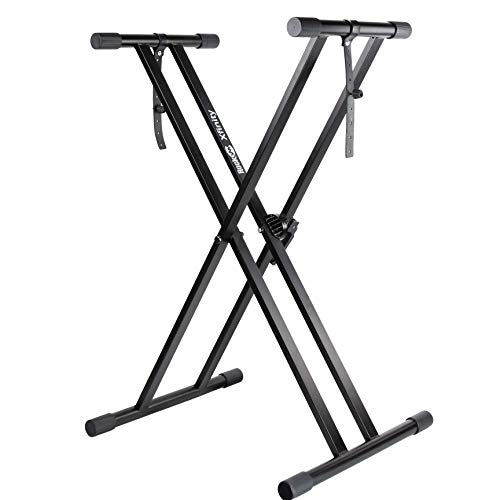
Best for: anyone who wants one stand that handles a 61-key beginner board today and a heavier 88-key digital piano later. Skip if: you play out weekly and carry the stand up stairs, because a double-X frame is heavier than a single-X.
The reason a double-X frame wins this guide is geometry. Two crossing pairs of legs resist the side-to-side rocking that makes a keyboard feel loose when you play with force. If you press hard on the low octaves of a weighted 88-key board, a single-X stand tends to sway a little, while a braced double-X holds the keyboard level. That matters more than it sounds: a keyboard that moves slightly under your hands makes it harder to play fast passages cleanly.
The locking straps are the second reason. A strap that wraps over the keyboard body keeps it from creeping forward or being knocked off the arms by a child or a pet. On a laptop desk setup, where you reach across for a mouse or the laptop trackpad, it is easy to nudge the keyboard, so a locked board is a real comfort. The trade-off is setup time: you thread and tighten straps every time you move the board, which is a small chore if you pack it away daily.
For laptop users, the open frame under the keys is useful. A laptop on a separate small desk to the right of the stand keeps the screen at eye level while your hands stay on the keys. Pair it with a lightweight laptop stand so notation or music software windows sit near eye level.
Pros: sturdy design; locking straps; wide key-count range; folds flat. Cons: heavier than single-X; strap routine; weight and capacity not shown in the short listing.
2. GLEAM Single X Keyboard Stand: Best Value
- Single-X style, black finish.
- Capacity of 100 lb listed.
- Adjustable height (levels not listed).
- Foldable for storage.
Best for: a 61-key board that lives in one place, such as a bedroom or a corner of a home office. Skip if: your keyboard is a heavy weighted digital piano or you play with a heavy touch.
A listed 100 lb capacity is generous for a stand in this tier, but capacity is a static number. It does not tell you how much the frame flexes when you play. A common 61-key portable keyboard weighs a fraction of that, so you are far under the limit, and a single-X stand is perfectly adequate there. A weighted 88-key digital piano can weigh 30 to 50 lb on its own, and a single-X stand will carry it, but the flex is more noticeable, so we would rather see those boards on a double-X frame.
The single-X design has an advantage for tight spaces: it folds into a thin bundle that slides behind a door or a wardrobe, and the legs do not cross in front of your knees as much as a double-X does. For a student who practices on a school night and puts everything away, that convenience is worth more than the extra bracing.
If the stand will also support a small laptop for a lesson app, keep the laptop on a separate surface. Single-X arms are not designed to carry two items, and a heavy laptop on one side upsets the balance.
Pros: budget tier; listed 100 lb capacity; folds thin; simple to adjust. Cons: more sway than double-X; locking straps not listed; best kept to light and mid-weight boards.
3. RockJam Xfinity Double X: Best Budget Double-X
- Double-X frame, pre-assembled (as listed).
- Adjustable height and width.
- Safety locking feature mentioned in the listing.
- Portable and foldable.
Best for: beginners who want a stable stand out of the box without reading a manual. Skip if: you need a precise width range to match a specific 88-key model, since the short listing does not show one.
Pre-assembled means the legs and the cross braces arrive joined. You open the stand, set the height and tighten the locks. That removes the most common frustration with entry-level stands: a bag of bolts and a vague diagram. For a parent buying a first keyboard for a child, this is a real convenience. It also lowers the chance of a mis-assembled stand that wobbles for no obvious reason.
The double-X structure gives you the stability advantages described above at a lower tier than some competitors. The compromise is that you may find the arms less cushioned and the finish plainer than on premium stands. Check the arm padding if your keyboard has a plastic body that scratches easily.
Because the listing text we reviewed does not give a numeric capacity, we advise treating it as a stand for light and mid-weight boards, and checking the maker page for the exact figure before putting a heavy digital piano on it.
Pros: pre-assembled; double-X bracing; locks; mid-range price tier. Cons: capacity not listed; width range not listed in the short title; basic finish.
4. Liquid Stands Z-Style Stand: Best Premium
- Z-frame design, adjustable and portable (as listed).
- Marketed for kids and adults; the listing mentions fitting a range of keyboard sizes.
- Heavy-duty positioning in the listing title.
Best for: wide 76 to 88 key boards, stage use and anyone who wants a stand that sits close to the player with room for the knees. Skip if: you are on a tight budget or you only need a stand for a small 61-key board.
Z-style stands hold the keyboard from two points and the frame forms a Z shape from the side. The benefit is that there are no legs crossing under the keys, so your knees and a sustain pedal have more space. This is useful when you play seated at a low bench, because an X stand’s crossing legs can bump your thighs. A Z-style frame is also quick to open and close, which is why it is popular for live use.
The trade-off is that a Z stand concentrates the load in two arms, so the quality of the locks and the width of the base matter more. Premium stands justify their tier by using thicker tubing and better adjustment mechanisms. Since the listing does not state a numeric capacity in the title, check the maker page for the number before pairing it with a heavy board.
In a laptop-and-keyboard desk, the Z frame’s open front lets you slide a small rolling laptop table next to your knees. This is one of the more flexible arrangements for notation or beat-making.
Pros: room for knees; quick setup; suitable for wide boards; premium build positioning. Cons: premium tier; capacity not listed in the short title; locks must be set correctly.
5. Natapai Stand and Bench Set: Best Stand and Bench Set
- Double-X piano stand with a bench (as listed).
- Adjustable stand height with 7 levels.
- Foldable design; heavy-duty positioning.
Best for: new players who need both a stand and a seat at the right height. Skip if: you already own a good adjustable bench or chair.
Seat height is the thing beginners forget. A dining chair is usually around 18 inches high, which is a bit low for many adults at a piano; a piano bench tends to be a little higher and, importantly, has no back or arms that get in the way of your elbows. A set takes that variable out of the decision. The stand’s seven height levels give you room to find a key-top height that places your forearms roughly level with the keys, which is the traditional goal.
The trade-off with sets is that the bench is a secondary part. Check its padding and the ease of folding. If you have a long practice session, a thin cushion is tiring. The bench height range is not listed in the short title, so confirm that before purchase if you are tall or short.
For a laptop user, the benefit of the set is a consistent posture. When the bench is at the right height you can look at a laptop on a nearby table without twisting your neck.
Pros: stand and seat in one purchase; seven height levels; double-X stability. Cons: bench specs not listed; the bench may be basic; larger storage footprint.
6. Stage Rocker Single-X: Best for Small Rooms
- Single-X classic folding stand (as listed).
- Adjustable width and height.
- Marketed as durable and sturdy.
Best for: small apartments, dorm rooms and anyone who moves their keyboard between rooms. Skip if: you own a heavy weighted 88-key board.
The classic single-X is the stand most people picture. It is simple, folds quickly and costs less than double-X models. Its narrow footprint makes it comfortable to use in a 10 by 10 foot room, where every inch counts. If you share a space and need to clear the floor each evening, this is the style that fits that habit.
The compromise is the same as for any single-X: some wobble under hard playing. If you notice movement, check that the locking knobs are tight, set the stand lower, and place it on a non-slip mat or a thin rug. Setting the height lower brings the center of gravity down and makes the stand feel firmer.
Pros: simple; compact; budget tier; quick to fold. Cons: sway under heavy playing; capacity not listed; basic padding.
7. Pyle Heavy Duty Folding Z Stand: Best Z-Style Below the Premium Tier
- Reinforced Z design, adjustable width and height (as listed).
- Foam padded arms.
- Folding design.
Best for: players who like the Z-style layout but do not want a premium tier. Skip if: you need a published weight capacity, since the short listing does not show one.
Foam padding on the arms protects the underside of the keyboard and reduces rattle, which is a small but useful detail if you have a glossy plastic body. Adjustable width helps the stand fit different keyboard depths. Check that the arms can slide wide enough for your model; an 88-key board is typically around 52 inches wide, and the arms should sit well inside the end caps, not at the very edge.
As with all Z-style stands, a firm lock at the joint is essential. Make sure the locks are fully tightened before you put the keyboard on, and pull gently on the keyboard once it is placed to confirm it does not slide.
Pros: padded arms; Z layout leaves knee room; folds; mid-range tier. Cons: capacity not listed; Z frame depends on lock quality; less bracing than double-X.
Also Consider
- Bazayona Stand and Piano Bench Set: a double-X stand with lockable straps and a bench, an alternative to the Natapai set if you want straps included.
- tipatyard Double-X Keyboard Stand: a stand-only version for 54 to 88 key boards at a mid-range tier, useful if you already have a bench.
- tipatyard Stand and Bench Set: a heavy-duty double-X set aimed at beginners who want a seat included.
Decision Matrix by Situation
| Your situation | Stand style to favour | Why | Pick from this guide |
|---|---|---|---|
| 61-key board, bedroom corner, rarely moved | Single-X | Light load, small footprint | GLEAM Single X |
| 88-key weighted piano, home practice | Double-X | Extra bracing, less sway | GLEAM Double X |
| Frequent set-up and tear-down for gigs | Z-style or light single-X | Fast to open and carry | Liquid Stands, Stage Rocker |
| Need a seat as well | Stand and bench set | One purchase, matched heights | Natapai set |
| Laptop beside the keyboard for music software | Z-style for knee room | Space for a side table | Pyle Z or Liquid Stands |
| Unwilling to assemble | Pre-assembled double-X | Ready in minutes | RockJam Xfinity |
How We Chose
We shortlisted stands from the site’s product store that are currently sold, then compared the maker listing text for style (single-X, double-X, Z), stated key-count range, stated capacity, adjustability and extras such as straps and benches. We cross-checked general guidance from independent music-gear publications and the keyboard makers’ own manuals about stand width and playing height. We kept to two products per brand and left out items with a mismatched purpose, such as under-desk typing trays. We did not personally use these products, and nothing here is a lab result. Where a listing did not state a weight limit or width range, we wrote “not listed” and recommend checking the maker page before you buy.
Buying Guide
Match the stand to your keyboard width
Measure your keyboard from end to end. As a rough guide, a 61-key board is about 36 to 40 inches wide, a 76-key board is about 45 to 50 inches, and an 88-key board is about 50 to 54 inches. Many stands list a minimum and maximum arm span. The arms should support the keyboard well inside the end caps, ideally with 2 to 4 inches of overhang on each side rather than at the extreme edge, so the keyboard does not tip.
Check weight, not only capacity
Look up your keyboard’s weight in the manual. A portable 61-key board often weighs under 15 lb, an 88-key stage keyboard often weighs 20 to 35 lb, and a weighted digital piano can be 30 to 50 lb or more. Add a margin of 25 to 30 percent when comparing to the stand’s listed capacity, because a stand is stressed more by playing than by static weight. When the capacity is not listed, assume the stand suits light boards only until the maker confirms.
Single-X, double-X or Z
Single-X stands are the lightest and cheapest and suit a small, light board. Double-X stands add bracing and are the better answer for heavier boards and energetic players. Z-style stands leave room for the knees and are quick to open, but they depend on lock quality and a wide base. If you never move the stand, favour double-X. If you travel, favour a lighter single-X or Z.
Playing height
A standard piano key top sits about 28 to 29 inches off the floor. Most adjustable stands reach that range, and some go higher for standing play. If you sit at a bench around 19 to 20 inches high, aim for forearms that are roughly level with the keys. If your wrists are bent up or down when you play, adjust the stand by one level at a time until the position feels neutral.
Laptop and keyboard together
If you use a laptop with your keyboard piano, plan the layout before you buy. Keep the laptop on a separate stable surface. Do not balance it on the keyboard. Position the screen at eye level, and allow roughly 20 to 24 inches of depth for a laptop and a mouse next to your playing position. If you plan to add a tray to the stand, check its capacity separately.
Setup and care
Open the stand fully before adjusting the height, set both sides to the same level, and tighten every knob before the keyboard goes on. Lift the keyboard from the ends, never from the middle, and lower it onto the arms with both hands. Re-check the knobs every few weeks, because vibration can loosen them, and wipe the foam or rubber pads so dust does not make the board slide. Store the stand folded, away from damp floors, to protect the finish on the tubing.
Common Mistakes
- Choosing by key count only and ignoring the keyboard’s weight.
- Skipping the locks and straps because the stand feels steady when empty.
- Placing the stand on a slick floor without a mat.
- Setting the stand too high, which tires the shoulders.
- Using a dining chair instead of a bench.
- Putting a heavy laptop on the keyboard stand arm.
Frequently Asked Questions
What is the best stand for a keyboard piano?
A double-X stand such as the GLEAM Double X is the best all-round answer for most keyboards. It balances stability, adjustability and storage, and it suits keyboards from 54 to 88 keys.
Is a single-X stand good enough for an 88-key keyboard?
It can work for a lighter 88-key board if the stand’s listed capacity covers the weight with a margin, but a double-X stand is steadier. Check the keyboard’s weight in the manual and the stand’s capacity on the maker page.
Which piano stand for keyboard players gives the most knee room?
A Z-style stand gives the most knee space because it has no crossing legs under the keys. It is a good choice if you use a sustain pedal or sit close to the keyboard.
How high should a keyboard piano stand be?
Aim for key tops at about 28 to 29 inches off the floor for seated play, then fine-tune so your forearms are roughly level with the keys. A bench or chair around 19 to 20 inches high suits many adults.
Do I need a bench with a keyboard stand?
Not always, but a proper bench helps posture. If you already have an adjustable chair without arms, you can skip a set. Otherwise a stand and bench set is a simple way to get the heights right.
Can I put a laptop on a keyboard stand?
Not on the main arms. Use a separate laptop stand or a small table beside the keyboard. A laptop on the arms changes the balance and can scratch or overload the stand.
Will a stand fit every brand of keyboard?
Most adjustable stands fit common sizes, but depth and body shape differ. Check the arm span range, make sure the arms support the body, not just the end caps, and keep a few inches of overhang on each side.
Which One Should You Buy?
If you want one dependable stand for years, buy the GLEAM Double X. If you only need a simple stand for a light 61-key board, the GLEAM Single X or the Stage Rocker Single-X is enough. For a first-time purchase that includes a seat, choose the Natapai set. If you have wide boards, a pedal and a desire for knee space, look at the Liquid Stands Z-style, and consider the Pyle if you want a Z layout at a lower tier. Before you buy any of them, measure your keyboard’s width, check its weight, and confirm the capacity on the maker page.
Sources
- Manufacturer listing pages for GLEAM, RockJam, Liquid Stands, Natapai, Stage Rocker and Pyle stands
- Keyboard and digital piano owner manuals from Yamaha and Casio (stand and dimension guidance)
- Sweetwater buying guides on keyboard stands
- Guitar Center buying guides on keyboard stands
Last updated: October 2026


Write Your Review
No reviews yet. Be the first to share your experience!